Introduction
Converse is an American shoe brand founded in 1908 by Marquis Mills Converse in Malden (Massachusetts, USA), best known for its iconic Chuck Taylor All-Stars sneakers. Since 2003, the company has been part of Nike. Converse initially produced footwear for basketball, but the postwar economic boom allowed them to expand production and change their target audience from professional athletes to a mass audience.
The brand creates «new classics» that shape sports, street, and creative culture, believing that unlocking the creative spirit can change the world and bring people together. Key Values are сreativity, self-expression, authenticity, uniting people through culture.
Communication channels
Social Media
Converse actively uses global platforms (Instagram, Facebook, Twitter/X) for visual content featuring sneakers, collaborations, and cultural activities.
*Instagram is a product of the Meta company, whose activities are recognized as extremist and are prohibited on the territory of the Russian Federation. *Facebook is a product of the Meta company, whose activities are recognized as extremist and are prohibited on the territory of the Russian Federation.
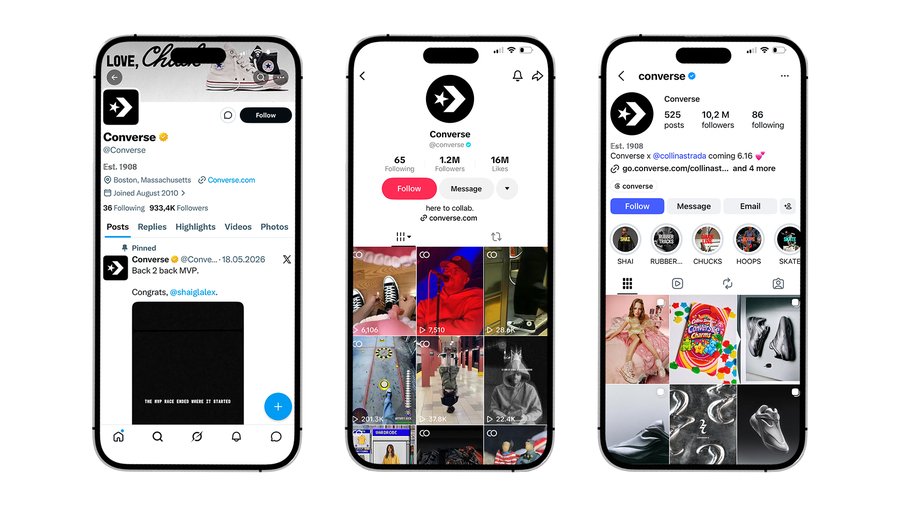
1. Converse social media accounts: Twitter/X, TikTok, Instagram*
PR Strategies
The brand focuses on collaborating with artists, musicians, designers, and cultural leaders to create collaborations. It also uses human-centered storytelling, integrating UGC (user-generated content) into PR materials.


2. Collaboration with singer Charli XCX. A limited edition model of «Party Girl» sneakers (2025)
3. Collaboration with Tyler, The Creator (2021)
Cultural Activations
The brand participates in music festivals, art exhibitions, and street culture, strengthening its connection with creative youth
Converse builds communication on authenticity and emotional connection, creating content that reflects the company’s values through stories of real people.


4. Converse Heritage Campaign «For Generations» at The Museum of Fine Arts in Boston, Massachusetts
Theoretical Framework
We will analyze the Converse brand through the lens of two theories: Social Identity Theory and Uses and Gratifications Theory.
Social identity theory developed by Tajfel and Turner. It explores how people construct their self-image and self-esteem through group membership. They categorize others, compare their «in» group with their «out» group, and strive for a positive social identity. Converse builds communication around the idea of «you are one of us» (as authentic, creative, bold, and free as they are). Customers don’t get sneakers, but the right to be part of this group, among others like themselves.
Uses and Gratifications Theory, developed by Elihu Katz, explores how people engage with media and what motivates them to do so. In this research, the theory will be used to examine how Converse’s brand positioning and communication strategies encourage consumers to engage with the brand on social media and generate user-created content.
Analysis: Social identity theory
Social Identity Theory is primarily concerned with groups and social categorization. This is the cognitive process of ordering and segmenting social environments. We divide people into groups to simplify our perception of the world. In the «Forever Chuck» campaign (2017), Converse deliberately created the category «young creatives» as an «in» group. One of the campaign’s final videos, for example, features musicians, artists, and skaters: diverse groups of individuals driven by a desire to live, express themselves and create. Interestingly, the video focuses on people and their individualities, while barely showing the product itself.
5. A fragment from the «Forever Chuck» campaign commercial (2017)
Continuing with the topic of groups, loyalty to one’s community, as well as trust, are most effectively demonstrated in smaller, more distinctive groups. In 2025, Converse created the «By You» collaboration with singer Charli XCX. The brand gave fans the opportunity to customize their sneakers through the «By You» platform: interchangeable patches with phrases like «XXX», «365», «Angel» and «Party Girl» key fobs, and signature lime-green insoles. In this case, Converse isn’t trying to appeal to «everyone.» They’re intentionally targeting a small but very close-knit group. After all, Charli XCX has a loyal, niche audience, primarily Gen Z and alt-pop fans.
6. Photoshoot for the «By You» advertising campaign (2025)
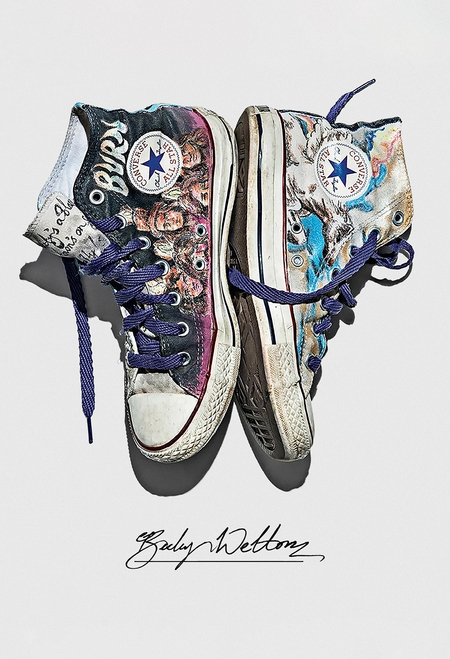
Members of a particular community often begin to perceive the fate of the group to which they belong as their own. This phenomenon is accompanied by a search for an answer to the question «who am I?» One of the most high-profile campaigns, «Made by You» (2015-2017), was built around this idea. The Chuck Taylor is a blank canvas. Scuffs, holes, and designs — all of this makes each pair unique and tells the story of the wearer. Converse created art installations in 41 cities around the world, displaying actual worn Chuck Taylors.
7. Posters from the «Made by You» advertising campaign (2015-2017)
8. «Made by You» advertising campaign (2015-2017)
This campaign demonstrates another crucial aspect of Social Identity Theory — Optimal Identity Theory (ODT). People strive to identify with groups that provide the optimal balance between the need for assimilation and the need for differentiation. Globally, all Converse wearers belong to this community, which at the same time allows everyone to feel unique. To be appreciated, you just need to be yourself, and it will be reflected in your sneakers.
9. A fragment from the «Made By You» campaign video (2015)
Moreover, Converse emphasizes Social Creativity in many of its advertisements, turning disadvantages and weaknesses into absolute advantages. There’s no need to worry about sneakers getting dirty or worn out over time: from this brand’s perspective, the shoes are only more valuable and better in this condition. Their simple and understated design is anything but boring: it literally becomes a canvas for your personal story and customization. Converse are inexpensive, but that doesn’t mean they’re bad: it’s a sign of accessibility — everyone is unique, and we can empower everyone to express that. The «Shoes are boring, wear sneakers» campaign (2013) effectively demonstrates the difference between more formal shoes that you don’t want to get dirty or damaged, and Converse sneakers that you can do whatever you want with. This is because it’s the fear that limits people, while Converse sneakers provide freedom through the fearlessness of doing whatever you want with them.


10. Fragments from the «Shoes are boring, wear sneakers» Converse commercial (2013)
Analysis: Uses and gratifications theory
Both strategies discussed above — positioning a product as a way to declare membership in a group and providing customization opportunities, enable Converse to effectively leverage the Uses and Gratifications Theory for commercial benefit.
According to the theory the audience is active. People consume media and come online because they are motivated by certain reasons. A study from the CyberPsychology & Behavior magazine found seven gratifications for Internet usage: information seeking, aesthetic experience, monetary compensation, diversion, personal status, relationship maintenance, and virtual community. [4]