Communication Theory in Design and Contemporary Art
Communication is not just about talking or writing; it’s a process of meaning-making that is vital in design and art as well. According to communication scholars, all definitions of communication converge on key features:
It is a process involving the exchange of messages. It uses verbal and nonverbal symbols to convey ideas. It occurs between at least two parties (a sender and a receiver). It leads to creating and interpreting meaning. It always happens within a context. It features feedback (the receiver’s response influences ongoing communication).
In other words, communication is continuous and relational: the designer or artist «encodes» a message into a design or artwork, and the audience «decodes» it, often in their own unique way. Personal experiences and cultural background can cause different interpretations of the same artistic message — much like how readers imagine a novel differently than its movie adaptation. Context plays a crucial role in this process: a message delivered in a gallery opening will be received differently than the same message shown on a social media feed. The setting, cultural environment, and audience expectations all shape how meaning is constructed when encountering a design or artwork.
Importantly, communication in design and art is symbolic. Designers and artists work with colors, shapes, images, and materials as symbols that carry meaning. This aligns with the semiotic tradition in communication theory, which views communication as the study of signs and how they produce meaning. A painting, a logo, or a piece of furniture can all be understood as sign systems: they stand for ideas beyond their literal form. For example, a minimalist geometric sculpture might symbolize modernity or «order» to its audience, depending on the cultural codes they bring to viewing it.
Communication theory also emphasizes that meaning is co-created socially, not just transmitted. The socio-cultural tradition sees communication as the creation of social reality through interaction. In the context of art and design, this means that a work doesn’t have a single inherent meaning; rather, meaning emerges through the interaction between the piece, viewers, and the cultural context. A contemporary art installation might spark different conversations — each viewer’s interpretation adds to the tapestry of the artwork’s meaning in society. Design, too, can shape social reality: think of how the design of a public space encourages certain behaviors and interactions. The socio-cultural perspective reminds us that communication (and thus design/art as a form of communication) is deeply influenced by cultural norms and can reinforce or challenge those norms.
Furthermore, design and art often aim to persuade or affect the audience, whether it’s persuading someone to feel a certain emotion, to adopt a new viewpoint, or simply to consider an object «beautiful» or desirable. This is where the rhetorical tradition informs our understanding. The rhetorical view treats communication as the art of persuasion. An advertisement design, for instance, is explicitly rhetorical — it uses visual and textual rhetoric to persuade you to buy a product. Even in fine art, a piece might be making a persuasive argument (for example, a political artwork persuading viewers to question something about society). Good communicators in the rhetorical sense will adapt their message to their audience and context, choosing the right strategies to achieve the desired effect. In design terms, this could mean tailoring a message differently if the piece is for a children’s museum versus a corporate office, much as a speaker adjusts their tone and examples for different audiences.
To summarize, communication theory provides a rich framework for understanding how design and contemporary art «speak» to people. A designer is like a communicator who must encode ideas (messages about function, feeling, identity) into a visual form. The audience, in turn, decodes those ideas, providing feedback (even if just through their reactions or purchasing choices). The process is contextual and symbolic: meaning depends on cultural context and the use of shared symbols. Different theoretical traditions in communication offer lenses to analyze this:
Semiotic tradition: Focuses on signs and symbols. In design/art, this highlights how visual elements signify deeper meanings (e.g., a red rose in a painting signaling love or passion). Designers consciously choose elements that will trigger the right associations in the audience’s mind. Socio-cultural tradition: Emphasizes how communication forms and reflects our social reality. A design or artwork’s meaning is shaped by social context — for instance, a minimalist design might communicate «elegance» and a certain social status within a culture that values minimalism. This tradition reminds designers/artists to consider cultural context and how their work might reinforce or challenge social norms. Rhetorical tradition: Sees communication as persuasive and audience-centered. Applied to design/art, this means crafting works intentionally to influence audience response — whether that’s an emotional reaction, a call to action, or an intellectual engagement. The rhetorical perspective encourages attention to audience adaptation: who is the viewer/user and how can the design best reach them?
These traditions (among the seven classic traditions identified by Craig) are especially pertinent to how design and art communicate. By understanding communication as a dynamic process of encoding/decoding meaning, shaped by context and culture, and directed by strategic choices, designers and artists can more effectively craft works that resonate with their intended audiences.
Presenting «LVL» to a General Audience
Imagine walking into a living space that feels like a calm, modern game world — not a cluttered arcade, but a serene «level», of a game brought to life. LVL is a new minimalist interior brand that does exactly this. It takes inspiration from the structure and aesthetics of video game levels and transforms real spaces into something both futuristic and inviting. For anyone who loves sleek digital aesthetics and modern minimalism, LVL offers a chance to «level up» your living space in a truly unique way.
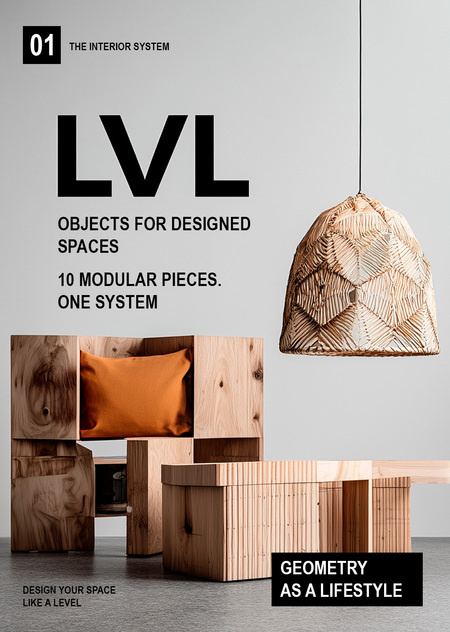
At its core, LVL reimagines common interior objects as if they were artifacts from a stylish game universe. Picture a coffee table that looks like it could be a platform from an architecturally beautiful puzzle game, or modular wall shelves that stack like elements of a level layout. The design language is clean and geometric — every line and shape has purpose, much like in a well-designed game environment. Yet it’s not cold or abstract; it’s conceptual modern interior design that remains warm and livable. The materials are high-quality and the forms are simple, so even though the inspiration is digital, the feeling in your home is cozy and human.
What makes LVL special? It speaks to the child-at-heart and the design-lover at the same time. The brand knows that many people today grew up with video games and also developed a taste for contemporary design. LVL blends these worlds. The furniture and décor pieces are based on modular forms — think of building blocks or level tiles that you can rearrange. This means you aren’t stuck with one configuration; you can play with the setup of your space. In a sense, youbecome the designer of your own level, moving pieces around to suit your mood or your needs. It’s a playful approach, but also grounded in functional design. Each object serves a purpose as a table, a seat, a shelf, or a lamp, but looks like it was pulled from a digital landscape and refined into an elegant physical form.
official interior 2
The visual logic of game worlds is evident in LVL’s color and lighting choices too. The palette tends toward neutral tones with occasional bold accents, much like a minimal game might use a splash of color to guide you. Subtle LED lighting is used in some pieces (for example, a floor lamp with a soft glow along its edges) to mimic the ambient lighting of a virtual level and create a relaxing atmosphere. These are interiors that feel interactive even if they aren’t electronics — they invite you to engage, reconfigure, and imagine.
LVL’s target audience is people who appreciate this blend of digital and physical aesthetics. You might be a tech-savvy individual who loves the idea of your living room reflecting the sleek design of your favorite game or sci-fi film. Or you might be an art enthusiast drawn to conceptual, minimalist installations — the kind that make you think differently about space. Either way, LVL is accessible and user-friendly: it isn’t heavy theory or overly expensive art; it’s practical décor with a creative twist. The brand communicates in a straightforward, friendly tone, explaining its pieces in plain language. For example, a product description might say, «This is Level Table — a coffee table inspired by floating game platforms. Stack two to create a tiered effect, or separate them when you need extra surfaces.» Jargon is kept to a minimum, so anyone can grasp the idea and get excited about it.
official interior 1
Ultimately, LVL for the general audience is about transformation and imagination. It lets you see your home as something more than just rooms with furniture — instead, it’s like an ever-evolving level in a game, where you can change the layout and design. Yet it never loses sight of comfort and simplicity. The communication from LVL emphasizes how easy it is to incorporate these pieces into your life. No complicated setup, no garish gamer gimmicks — just clean lines, modular design, and a dash of digital-era magic. It’s an invitation to turn your personal space into a minimalistic game level that reflects you, providing both aesthetic pleasure and a sense of play. In short, LVL asks: why live on one level, when you can live on the next level?
Presenting «LVL» to a Professional Audience
home interior 1
LVL is positioned at the intersection of product design, spatial aesthetics, and digital culture — a convergence that offers rich discussion for curators, designers, and industry experts. In professional terms, LVL is an exploration of how game design principles can inform physical space-making. The brand’s collection of interior objects demonstrates a clear lineage from modular design systems and architectural minimalism, while also drawing conceptual influence from the logic of video game «levels.» By doing so, LVL bridges the language of digital environments with tangible furniture and décor, creating a hybrid design vocabulary.
LVL brand catalog 1
At a glance, the LVL line includes furniture and decorative modules that are deliberately minimalist in form — clean geometries, grid-informed structures, and a limited, cohesive material palette. This minimalism isn’t merely an aesthetic choice; it’s a functional one that resonates with modularity and adaptability. Each piece is designed as a module that can stand alone but truly comes into its own through combination. Much like components in level design that can be rearranged to create different layouts, LVL’s furniture elements can be reconfigured to suit various spatial needs. For instance, a set of cubic seating units can be clustered as a bench, separated into individual seats, or stacked to form a display shelf. This reflects a systems-thinking approach commonly found in both video game design and modernist architecture.
home interior 2
Materiality is another focal point of LVL’s design philosophy. The brand deliberately chooses materials that convey a blend of the tactile and the technological. Surfaces might be matte black metal, echoing the sleek feel of high-end electronics, combined with natural wood or stone that grounds the piece in physical reality. The contrast between, say, a smooth concrete tabletop and an illuminated LED accent line, exemplifies LVL’s aim to merge the virtual and physical realms. This attention to material interplay not only provides visual interest but also speaks to durability and quality — crucial considerations for industry experts assessing a new product line. The pieces are built to be both aesthetically refined and structurally robust, suitable for a gallery showcase or a designed commercial space as much as for a home.
LVL brand catalog 2
From a spatial aesthetics perspective, LVL’s products do more than fill a room; they shape the perception of space. Each object is conceived as part of a larger spatial composition. Designers will note the influence of architectural forms — cantilevers, terraces, and voids — which relate to how game levels are often layered and structured. Placed in an interior, these items create a sense of depth and progression. For example, a low table might have tiered planar surfaces reminiscent of platforms, creating subtle visual «levels» within a room’s layout. This gives interior designers a new palette of forms to play with, enabling designs that guide users through a space much like level designers guide players through an environment.
home interior 3
Crucially, LVL situates itself in digital culture as well. This is not retro gaming kitsch, but rather a sophisticated commentary on how digital experiences influence modern expectations of interactivity and personalization. The brand engages with the idea that contemporary audiences (and by extension, clients and end-users) are accustomed to environments that they can tweak and control — a legacy of interactive media. LVL’s modular and reconfigurable nature gives a user interpretive agency: a curator or designer using LVL pieces in a project can treat them almost like a toolkit for storytelling within a space. Each configuration can convey a slightly different narrative or function, depending on how the modules are arranged and used. In essence, the user becomes a co-author of the interior environment, which aligns with trends in participatory and adaptive design.
LVL brand catalog 3
When communicating LVL to a professional audience, the language naturally becomes more technical and conceptual. The brand story highlights how LVL draws from established design paradigms — one might reference the narrative qualities of space or the Elaboration Likelihood of design elements for different users, in theoretical terms — while also presenting something novel. For example, an LVL briefing for designers would discuss how the collection employs a central design metaphor (the game «level») to drive coherence across products, ensuring that the line is conceptually tight. It would also emphasize research and precedents: LVL builds on modular design principles seen in works ranging from the Bauhaus’s functional blocks to contemporary parametric design, yet it introduces a unique twist by explicitly integrating game-level logic as a design inspiration. The result is a product line that is intellectually intriguing for experts — touching on nostalgia for digital forms in a way that’s filtered through a rigorous design process rather than mere pastiche.